Photographing whales in the polar night
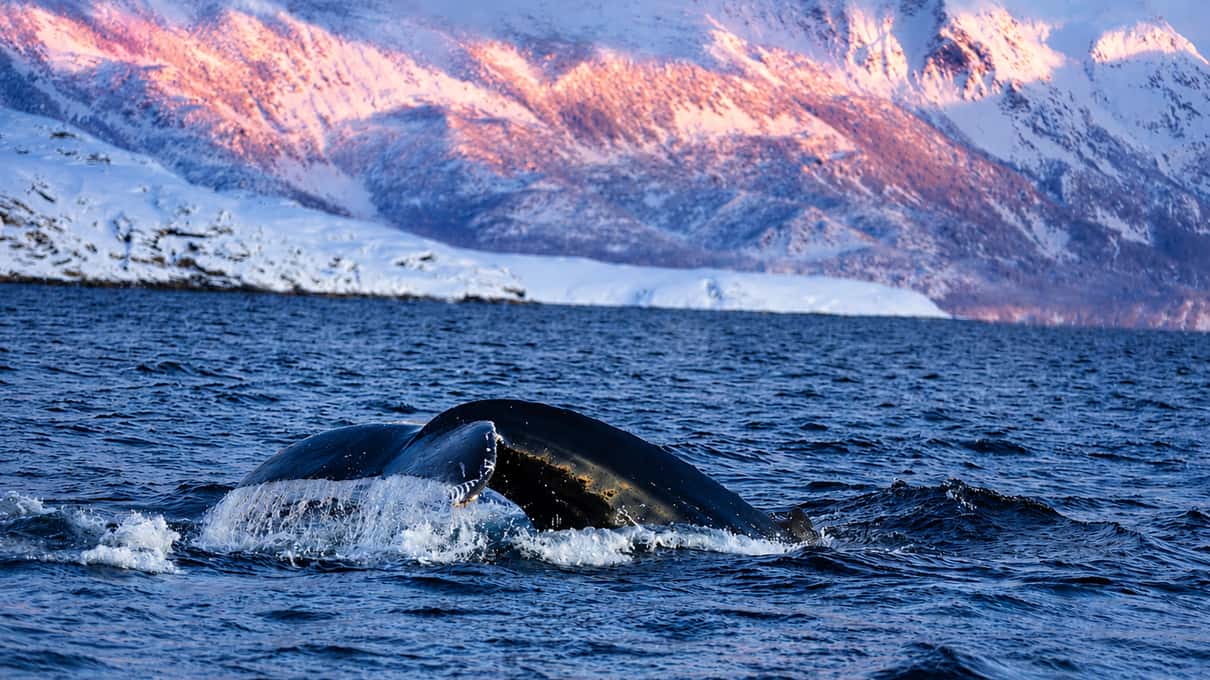
A whale in the polar night is a dark animal in dark water under a sky that never fully brightens. That is the hardest light most wildlife photographers ever work in, and phones struggle even more. Decide a few settings before you board and you can still come home with sharp pictures.
The light you get in midwinter
For roughly seven weeks either side of Christmas the sun stays below the horizon in Tromsø. You get a few hours of blue and pink twilight around midday instead, brighter on a clear day and close to dusk under cloud. The boats time their days around that window. Rødne's 8:30 am departure at ~$196 reaches the whale area near Skjervøy after about two and three-quarter hours and stays some two and a half hours, which puts you among the whales from roughly 11:15 am in the brightest part of the day.
By early afternoon the light is mostly gone and the trip home runs in the dark. Early in the season and from late January there is more daylight to work with. Our month-by-month guide covers how the light changes.
Settings that freeze a moving whale
Motion is the enemy twice over. The whale moves, and so does the deck under your feet. Use shutter priority or manual with auto ISO. Keep the shutter at 1/1000 s if the light allows, and never go slower than about 1/500 s for a whale at the surface. Open the aperture as wide as the lens goes and let the ISO climb as high as 6400 or beyond. A grainy picture of a sharp fin beats a clean picture of a blur, and modern noise reduction cleans up a lot afterwards.
Switch autofocus to continuous mode with a cluster of focus points in the center. Shoot short bursts when a back breaks the surface. Shoot RAW if your camera allows it, because dark water below pale snowy mountains stretches a file to its limits. Turn the flash off. It lights only the spray in front of you and annoys everyone on deck.
| Light | Shutter | Aperture | ISO |
|---|---|---|---|
| Pink twilight around midday, clear sky | 1/1000 s | Widest | Auto with a ceiling near 3200 |
| Overcast midday or deep blue afternoon | 1/500 s | Widest | Auto with a ceiling of 6400 or more |
| Brighter days in November or February | 1/1600 s | f/5.6 to f/8 | Auto |
Treat these as starting points. Check the screen after the first burst and adjust before the next whale comes up.
Which lens to bring
A telephoto zoom is the workhorse. Something in the range of 100–400 mm on a full-frame camera, or a 70–300 mm on a smaller sensor, covers a humpback at a polite distance as well as an orca that swims past the hull. Fixed super-telephotos look impressive but can be too tight when orcas come close, and they are heavy to hold up for two hours on a moving deck. A fast 70–200 mm f/2.8 gathers far more light and works well when the animals are near.
Keep a phone or a second body with a wide lens for the scenery, since the snowy mountains behind a fin are half the picture. How to spot and tell the species apart helps you know where to aim before the animal surfaces.
Shooting with a phone
Phones do well with the scenery and badly with distant whales. Night mode is the trap. It holds the shutter open for a second or more and turns a moving fin into a smear, so switch it off. Use the telephoto lens if your phone has one (often marked 3x or 5x) and stop zooming there. Digital zoom beyond the optical lens only enlarges the blur.
Hold the shutter button for a burst. Tap the whale to set focus and brace your elbows on the rail. Video often works better than stills in this light. Film in 4K and pull single frames out later. Wipe the lens often, since salt spray dries into a film that softens everything.
Tips from wildlife photographers
Skua Nature's heated boat (from ~$383) takes 12 guests and has wildlife photographers on board who give tips, plus an ethologist as nature guide. It suits anyone who came mainly for the pictures.
Keeping gear dry and warm
Spray and snow are the obvious threats. A rain cover or a plastic bag with a hole for the lens keeps the worst off. A lens hood stops drops landing on the front element. The less obvious threat is condensation. Moisture forms on and inside the lens when a cold camera goes straight into a warm lounge. Seal the camera in a plastic bag or a zipped camera bag before you go inside, then let it warm up slowly before you open it.
Carry spare batteries in an inside pocket where body heat keeps them going. Swap them as soon as the camera starts to complain. Our clothing guide explains the liner gloves that let you work the buttons without freezing your fingers.
On a RIB the rules change. The Skjervøy RIB from Arctic Adventure Tours at ~$334 says cameras come at your own risk and advises a waterproof bag, and with spray coming over the bow a big lens rarely leaves it. The Magic Skjervøy RIB at ~$353 includes photos in the price, which frees you to watch. How the boats compare covers the viewpoint each one gives you.
Deck manners
- Share the rail. Take your shots and step back so the next person can see. Our pick at ~$217 carries at most 90 guests on 147 seats and promises everyone a spot at the rail, but even there the front row fills fast when a pod surfaces.
- Leave the tripod at home. It takes up deck space and a moving boat makes it useless. Hand-holding is faster anyway.
- No drones. Rødne bans them outright, and flying one near whales breaks the guidelines that careful operators follow. How the guidelines work.
- Keep the noise down. On the Brim hybrid-electric boat at ~$196 the engine goes silent near the whales and you can hear the blows. Do not shout over them.
- Let the captain set the distance. The guidelines decide how close the boat goes, not the angle you want.
- Mind the glass. Shooting through lounge windows works if you press the lens hood against the pane to cut reflections.
Know when to stop
Some tours take the pressure off. Besides the Magic Skjervøy RIB, the MV Quest overnight expedition at ~$439 sends its pictures to guests within 48 hours. On any boat, give yourself a few minutes with the camera down. The sound of a humpback breathing in the twilight is what people remember, and no lens records it.