Which whales you can see from Tromsø
The whales off northern Norway in winter are not there for the scenery. They come for herring, and that one fish explains where the boats go. It also explains why you see some species far more often than others.
It starts with the herring
Every winter a huge stock of Norwegian spring-spawning herring moves into the fjords of northern Norway to wait out the dark months, before heading south down the coast to spawn. Orcas and humpbacks follow the fish. Where the herring settle changes over the years. A decade or so ago they wintered close to Tromsø, and the whales fed in fjords a short sail from the city.
In recent winters the schools have gathered further north in the waters around Skjervøy and Kvænangen. That is why the day boats now sail for two and a half to three and a half hours each way. Our Skjervøy guide explains the shift and the bus-plus-boat tours that follow it.
The whales usually arrive in late October or November and stay into January or sometimes February. December and January are the peak months. When to go walks through the season month by month.
Orcas
Orcas, also called killer whales, are the most striking animals out there. They are black above with a white patch behind each eye and a pale grey saddle behind the dorsal fin. The fin tells you who is who. An adult male carries a tall, straight fin that can reach about 1.8 m (6 ft), while females and young whales have a shorter, curved one.
Norwegian orcas live in family groups and specialize in herring. They work together to herd a school into a tight ball near the surface, slap it with their tails to stun the fish and then eat them one at a time. Researchers call it carousel feeding. From the boat you see fins circling and white splashes where tails hit the water, with gulls diving into the middle. Orcas are curious. Now and then a pod swims right past the hull.
Humpbacks
Humpbacks are much bigger, around 12 to 16 m as adults. Their long flippers can reach about a third of the body length, and the small dorsal fin sits on a hump, which gave the species its name. The first thing you notice is usually the blow, a bushy column of breath several meters high that hangs in the cold air. When a humpback dives deep it arches its back and lifts its tail, showing the pattern on the underside that researchers use to identify individuals.
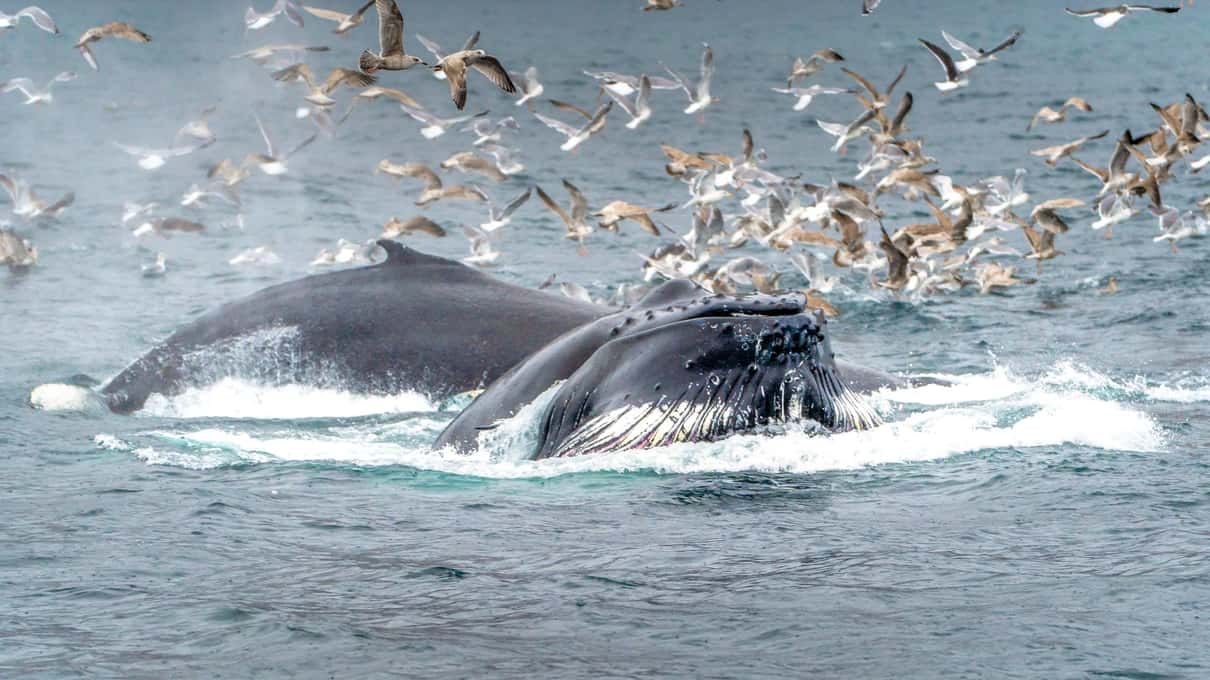
In the fjords they often feed close to the orcas, lunging up through the herring ball with their mouths wide open and taking advantage of the fish the orcas have gathered. Many of these humpbacks later swim thousands of kilometers to breeding waters in the Caribbean or off West Africa.
Fin whales and the rarer visitors
Fin whales are the second-largest animals on earth and turn up regularly among the herring. They are long and sleek, with a tall narrow blow and a small swept-back fin far down the back. They rarely lift the tail. Minke whales are smaller, about 7 to 9 m, and easy to miss because their blow is faint and they surface only briefly. Sperm whales live mostly along the deep shelf edge farther out to sea and appear in the fjords only now and then.
Skua Nature names four possible species for its trip (orcas and humpbacks plus minke and fin whales), which is a fair summary of the season. Smaller animals fill the gaps. Harbor porpoises show a small triangular fin and tend to keep away from boats. White-tailed eagles, with a wingspan of well over 2 m, are a common sight along the coast.
How to tell them apart
| Species | Size | Blow | Fin and tail | Usually seen |
|---|---|---|---|---|
| Orca | 6–8 m | Short and low, visible in cold air | Tall black fin; tail rarely shown | Circling herring in family groups |
| Humpback | 12–16 m | Tall and bushy | Small fin on a hump; tail lifted before deep dives | Lunging through the herring, often near orcas |
| Fin whale | Around 20 m | Tall and narrow | Small swept-back fin far back; tail rarely shown | Fast passes along the feeding area |
| Minke whale | 7–9 m | Faint or invisible | Small curved fin; tail not shown | Brief surfacings, often alone |
| Harbor porpoise | Under 2 m | None visible | Small triangular fin | Quick rolls at the surface |
Out with the herring hunters
Our pick sails a 147-seat catamaran with a heated lounge and an open top deck to the feeding grounds, from ~$217. If you see no whales, you can join another tour for free on any date with space during the season.
What a sighting looks like
Expect backs and fins more than leaping whales. Most of the time you watch blows hanging in the air and dark backs rolling through grey water. When a humpback dives, its tail lifts against the mountains. Breaches happen, but rarely enough that the guide will cheer. Gulls are the giveaway, because a crowd of them circling low over one patch of water usually means orcas are feeding underneath.
The boats keep a set distance under the local guidelines. Binoculars or a long lens help. Orcas do not read the rules, though. Sometimes they surface right beside the boat. How the distance rules work is in its own guide, and our camera guide covers settings for the low light.
Time with the whales varies a lot by tour.
- Brim's hybrid-electric boat, ~$196. 1–1.5 h with the whales, on a silent electric motor near them.
- Rødne's high-speed catamaran, ~$196. About 2.5 h in the whale area.
- Polar Adventures Max 50, ~$235. 2–2.5 h, and it says it is the first boat at the whales.
- Skua Nature's heated boat, ~$383. 3–3.5 h on the water after the bus to Skjervøy.
- MV Quest's 24-hour expedition, ~$439. Guests wake up already among the whales, hours before the day boats get there.
When the herring do not cooperate
No tour guarantees whales. Brim claims a success rate above 95 percent, but the herring can shift and a season can end earlier than planned. Most operators soften the risk. Our pick lets you join another tour for free, Rødne offers a free second tour booked at the Destination Tromsø booking point, and MS Gabriele at ~$209 gives a free second ticket in the same season. Every second-chance policy compared is in its own guide.
If the long crossing worries you more than the whales do, read our seasickness guide before you book.